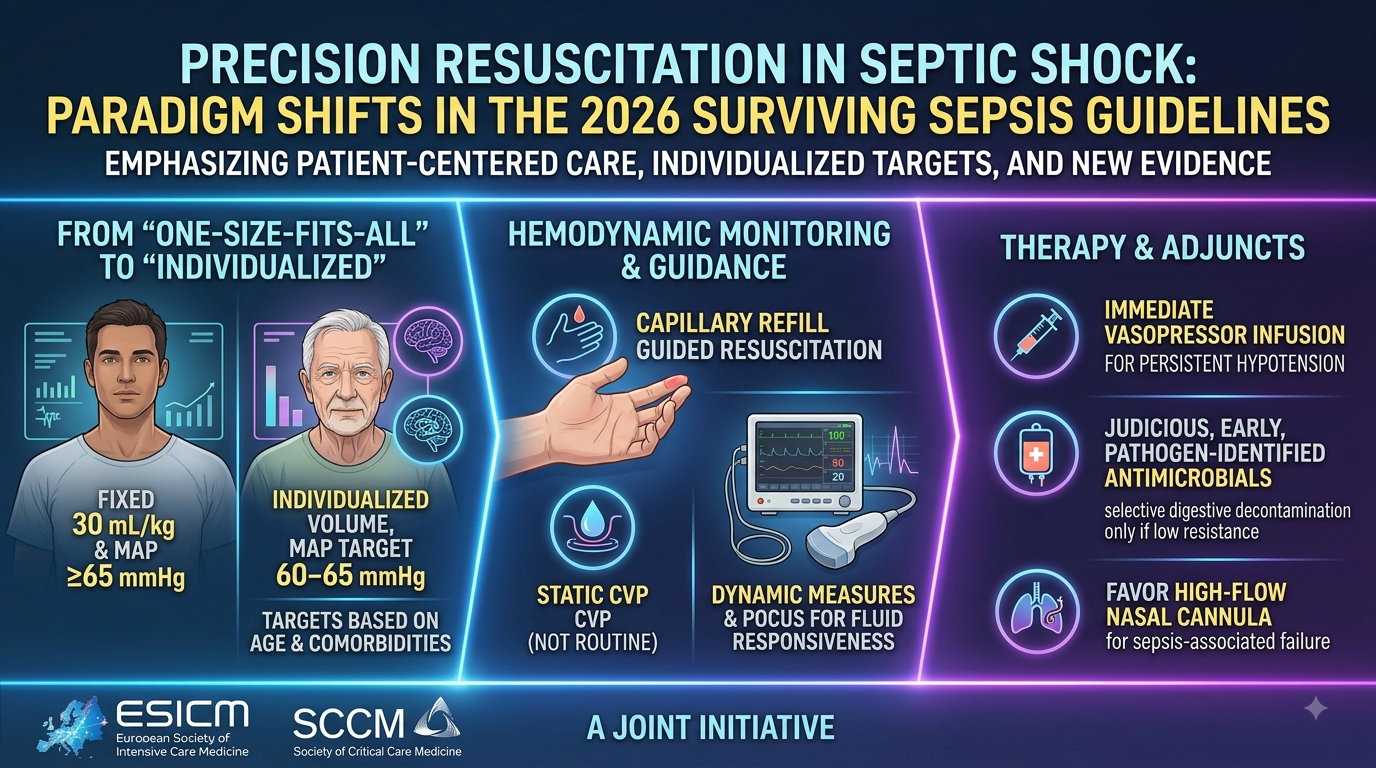
- Clinical Protocol: The 2026 guidelines pivot from fixed-volume fluid resuscitation to a precision, conditional approach, mandating dynamic responsiveness assessment to avoid volume overload risks.
- Diagnostic Impact: Dynamic fluid responsiveness assessment via tools like PPV, SVV, PLR, and POCUS (LVOT VTI, IVC collapsibility) is now mandated before fluid administration, replacing static metrics.
- Actionable Protocol: Early norepinephrine initiation (within first hour) to maintain MAP, coupled with microvascular monitoring (e.g., CRT), is recommended to restore perfusion while mitigating fluid accumulation.
- Technological Integration: AI-powered closed-loop systems are emerging to automate vasoactive titration, promising improved hemodynamic stability and reduced clinician burden during septic shock resuscitation.
Precision Resuscitation in Septic Shock: Paradigm Shifts in the 2026 Surviving Sepsis Guidelines
Managing septic shock in intensive care units requires balancing rapid pathogen eradication with nuanced hemodynamic stabilization. While protocolized resuscitation traditionally relied upon uniform fluid administration thresholds, the 2026 Surviving Sepsis Campaign (SSC) guidelines mark a definitive paradigm shift toward precision, patient-tailored hemodynamics. By integrating early vasoactive support, continuous dynamic fluid responsiveness assessment, and microvascular monitoring, clinicians can mitigate hypoperfusion while avoiding the metabolic and pulmonary consequences of volume overload.
The Pitfalls of Fixed Volume Resuscitation
For over two decades, early goal-directed therapy advocated an immediate 30 mL/kg crystalloid bolus for patients presenting with sepsis-induced hypoperfusion or elevated serum lactate. While initial fluid loading restores circulating arterial volume in severe hypovolemia, unguided fluid administration beyond early stabilization carries substantial clinical risks.
Sustained crystalloid loading accelerates endothelial glycocalyx degradation, destabilizes tight junctions, and worsens capillary leak. The resulting interstitial edema manifests clinically as prolonged mechanical ventilation requirements, acute kidney injury from renal compartmental hypertension, and increased overall mortality. The 2026 guidelines reflect this physiological reality by shifting fluid administration from a fixed rule to a conditional recommendation that demands continuous individual reassessment.
Dynamic Responsiveness: Replacing Static Metrics
Static indices such as central venous pressure (CVP) or static mean arterial pressure targets fail to predict whether additional fluid boluses will increase cardiac output. The updated framework mandates prioritizing dynamic measures of fluid responsiveness before committing to fluid administration:
- Pulse Pressure Variation (PPV) and Stroke Volume Variation (SVV): Waveform analysis evaluating cardiopulmonary interactions in fully passive, mechanically ventilated patients.
- Passive Leg Raise (PLR) Test: A reversible autotransfusion maneuver that shifts approximately 300 mL of venous blood from the lower extremities toward the right atrium. A transient stroke volume increase of ≥10% via arterial line or cardiac output monitoring confirms volume responsiveness.
- Point-of-Care Ultrasound (POCUS): Serial echocardiographic assessment of left ventricular outflow tract velocity time integral (LVOT VTI) and inferior vena cava collapsibility.
Early Vasopressor Initiation and Microvascular Perfusion
Delaying vasoactive agents until litany of fluid boluses complete frequently exacerbates vascular collapse. The 2026 guidelines advocate early initiation of peripheral or central norepinephrine infusion—often within the first hour of resuscitation—to maintain arterial tone and restore mean arterial pressure (MAP) to a initial baseline target of 65 mmHg (or lower personalized targets in geriatric cohorts). Early vasopressor support increases effective circulating volume by recruiting stressed vascular volume without fluid accumulation.
Simultaneously, clinicians are encouraged to integrate microvascular bed evaluations alongside systemic metrics. Bedside assessment of capillary refill time (CRT)—a rapid, non-invasive indicator of peripheral perfusion—complements serum lactate clearance and urine output monitoring, providing a real-time window into tissue oxygenation.
Integration of AI and Automated Closed-Loop Control
As ICU monitoring technology advances, closed-loop physiological systems are demonstrating significant utility in maintaining hemodynamic stability. By combining continuous invasive pressure inputs with algorithmic vasoactive titration, automated systems built using Artificial Intelligence (AI) incorporating various ICU informatics, could minimize MAP fluctuations out of target range, reducing clinician cognitive fatigue during acute resuscitation ensuring better outcomes.
References
- Evans L, Rhodes A, Alhazzani W, et al. Surviving Sepsis Campaign: International Guidelines for Management of Sepsis and Septic Shock 2021. Crit Care Med. 2021;49(11):e1063-e1143. doi:10.1097/CCM.0000000000005337
- Surviving Sepsis Campaign: International Guidelines for Management of Sepsis and Septic Shock 2026. Critical Care Medicine & Intensive Care Medicine. 2026. SCCM/ESICM Guidelines.
- Monnet X, Shi R, Teboul JL. Hemodynamic management of septic shock: beyond the Surviving Sepsis Campaign guidelines. Clin Exp Emerg Med. 2023;10(3):255-264. doi:10.15441/ceem.23.088
- Using the 2026 Surviving Sepsis Campaign Guidelines in Practice. Crit Care Sci. 2026;38(2):112-124.
Academic Collaboration & Consulting
Select a clinical research or writing service below to inspect deliverables and submit an immediate, direct inquiry to Dr. Rahul Parajuli.
Article Review & Literature Review
Rigorous scientific evaluation of medical literature and manuscript drafts. Providing structured peer-review quality assessments, methodology audits, and exhaustive literature mapping for prospective studies or clinical guidelines.
Key Deliverables & Methodologies:
- Critical Appraisal & Peer Review Reports
- Systematic Literature Search & Evidence Mapping
- PRISMA-compliant Literature Reviews
- Methodological Quality & Risk of Bias Assessment

Dr. Rahul Parajuli
Physician & ResearcherPhysician, Clinical Informatics Researcher & Health-AI Architect. Specializes in acute critical care telemetry, full-stack biomedical engineering, Schema entity graph architectures, and high-performance search systems.


Community Discussion
0 Contributions